Authentication
How to check jewelry: hallmarks, clasps and stones
Read hallmarks, test metal safely at home, check clasps and settings, and know what a diamond grading report can and cannot tell you.
22 Oct 20264 min read
Read 585 and 750 stamps, spot gold plating, use a magnet the right way and skip risky home tests: how to tell if gold is real, at home and at a jeweller.
Authentication7 min readUpdated
To tell if gold is real, read the purity stamp, such as 585 for 14k or 750 for 18k, look for plating wearing through at edges and clasps, and check that a strong magnet does not pull the piece. These checks can rule a piece out, but none of them proves it is gold. For anything valuable, ask a jeweller to test it with an XRF analyser or an acid test.
Most gold jewellery is stamped with its purity, usually inside a ring band, on the clasp or on a small tag near it. Purity is shown in karats or in parts per thousand:
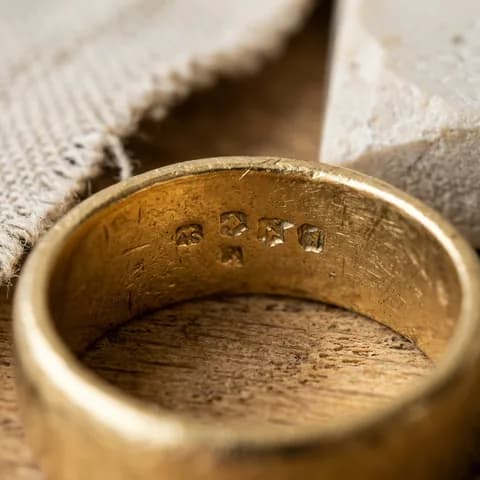
In countries with official hallmarking, such as the UK, an independent assay office tests the piece before marking it, and the hallmark includes the maker's mark, the purity and the assay office's symbol. In the US there is no official assay: the maker applies the stamp and must add a trademark next to a purity mark.
Many gold-coloured pieces are only coated with gold. The stamp often tells you, if you know the codes:
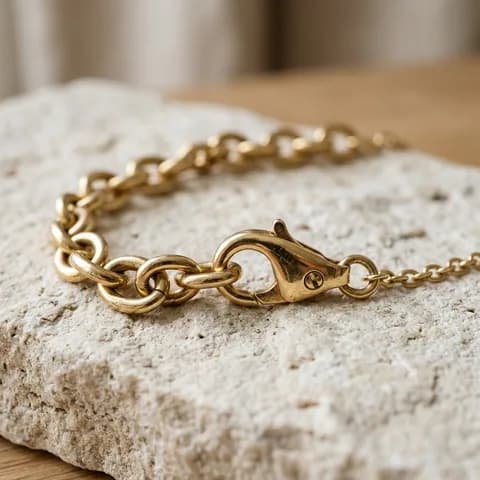
Gold is not magnetic, so a strong pull is a bad sign: it points to steel, iron or nickel inside. Use a strong magnet, such as a neodymium magnet, not a fridge magnet.
Gold is very dense: pure gold is about 19.3 times heavier than the same volume of water. A solid piece feels heavy for its size, and a jeweller can measure its density precisely.
Some popular tricks prove nothing and can ruin the piece or hurt you:
For a valuable piece, a professional test is worth it. Many jewellers and gold buyers test for free or for a small fee.
Gold is small and shiny: use soft daylight, no flash, and tap to focus on the stamp itself. These shots carry the most evidence: